
Chornobyl: A Photo Essay of the Exclusion Zone
In April 1986, an explosion at Reactor No. 4 of the Chornobyl Nuclear Power Plant caused one of the worst nuclear disasters in history. Pripyat and the towns around it were evacuated within days and have sat empty ever since. I've been into the Chornobyl Exclusion Zone twice, in 2008 and 2009, and this is what I found there.
Foreword: Why Something So Dangerous?
Photography has given me a lot of interesting, often fleeting experiences over the years. With landscape photography, that usually means getting away from the noise of daily life into quiet, remote places where I can slow down and actually look at the world. I've also always been drawn to going off the beaten track, visiting places most people don't (a pursuit that's picked up the name Urbex, or urban exploration, photography). The Chornobyl Exclusion Zone has become something of an "extreme" attraction for a certain crowd in recent years, but let's be clear: it's still not a place you'd take the kids on holiday.
I can still remember sitting in front of the TV after dinner in 1986, in Norwich, England, listening to news reports about a massive explosion at a power plant in a far-off place called Ukraine. They told us a radioactive cloud was drifting over the UK, settling on Welsh farmland, possibly contaminating crops and livestock. In the weeks after, with all the naivety of a young boy, I'd stand in the school playground looking up at the sky, thinking, "Well, I don't see anything up there."
Nuclear power has held my interest ever since. From atomic weapons and eerie gas masks to the invisible danger of radioactive particles, it's still the most frightening thing humans have ever discovered, and something that demands real respect, both as an energy source and as a weapon of mass destruction. By the time the 21st century rolled around, it had started to feel like Chornobyl might actually be a place I could visit. Information on the zone was growing fast online, and a handful of video games let you explore it virtually, which only reignited my interest and got me looking into what most people still picture as a radioactive dead zone. I've now been twice, first in 2008 and again in 2009. Here I'd like to share some of the images from both trips, offer a few facts that might surprise you, and clear up some of the myths I picked up along the way. So settle in, grab a coffee, and come along.
The images that follow are drawn from those visits. They are not intended as spectacle, but as a record, of place, of time, and of the quiet traces left behind.
The Accident
In the early hours of April 26, 1986, the night shift in Reactor No. 4 of the V.I. Lenin Memorial Chornobyl Nuclear Power Station was running tests that had been postponed from the previous day. They wanted to know if the plant could keep running on backup generators if it lost all electrical power. A poorly designed RBMK-1000 reactor, combined with inadequate operator training, led to overheating. A sudden surge in steam blew the reactor's 1,000-ton lid clean off, destroying the roof and sending tons of nuclear fuel and radioactive graphite into the atmosphere. Atomic agencies rated it a Level 7 disaster, a full nuclear meltdown, roughly one hundred times stronger than Hiroshima and Nagasaki combined. Cesium, plutonium, strontium and iodine were among the elements released. Plutonium alone has a half-life of 24,100 years, so it'll be a very long time before this place is fit for people to live in again. That said, not every part of the 30km zone is contaminated. Wind patterns and other factors at the time meant some areas came through relatively unscathed, and a few even have people living in them today, more on that later.
Arrival — Entering the Zone
Access to the Chornobyl Exclusion Zone starts at Dityatki checkpoint, and it's the first sign you're somewhere serious. Guards with machine guns work the barrier, and one of them leaned right into our car window while our guide handed over our documents. I don't speak Ukrainian, so I had no idea what was being said between them, just the tone of it, which was enough to make the whole thing feel pretty tense. After a couple of minutes of checking, the barrier lifted and we were waved through.
Everything changed the second we were past it. Empty roads for miles, no traffic, nothing but the odd faded and overgrown bus stop seemingly in the middle of nowhere. It's a strange feeling, knowing you've just crossed into a place most people will never see.
In Chornobyl town, we stopped at Chornobyl Interinform for a briefing before heading further in, the dos and don'ts, and how to use the dosimeter. At one point our guide took the dosimeter away to have it calibrated, walking off into another room with it, out of our sight. My friend wasn't convinced it was coming back any more accurate than it left. I pointed out that if it lied to us, we probably wouldn't be around long enough to complain.
The Sarcophagus
The concrete sarcophagus you can see in the photo above was thrown up in the weeks and months after the accident, built fast because there wasn't time to build it right. Engineers knew they had to bury the remaining nuclear waste somehow to bring radiation levels down. Radiation is measured in sieverts. Background radiation anywhere on Earth normally sits around two to six microsieverts (µSv) per hour. Right around the sarcophagus, it's closer to six millisieverts (mSv) per hour, about 6,000 times the normal background level. Step behind or inside the Chornobyl visitors center (the pale building on the right of the image) and it drops off considerably. That yellow and grey structure bolted to the sarcophagus was added in 2006 or 2007 to shore up the outer wall, which had started to show signs of collapse.
By the time of my visits, the sarcophagus was already showing its age. It was only ever meant to buy time, not last forever, and cracks in the outer shell made that pretty clear. Ukraine knew it needed something bigger and better sealed to actually finish the job. A new containment structure for Reactor No. 4 was commissioned in 2007 and finally completed in July 2019, a 190-meter wide steel arch wheeled into place over the old sarcophagus so engineers can start working out how to dismantle what's left of the reactor safely.

Reactors 5 and 6, and the Other Incidents
These are the unfinished cooling towers for reactors 5 and 6, still under construction when the accident happened and left exactly as they were ever since. There's a lot of debris scattered around here, and it's hard to say what most of it actually is. Radiation levels swing wildly, at one point the dosimeter let out a warning loud enough to make us jump. The 1986 explosion wasn't the only incident at the plant, either. In 1982, Reactor No. 1 had a partial core meltdown, but Soviet secrecy kept it quiet for years, and the reactor was back online after only a few months. No deaths were ever reported. In 1991, five years after the explosion, a fire broke out in the turbine hall of Reactor No. 2, and that was the end of that reactor for good. Reactor No. 1 shut down in 1996, and Reactor No. 3, the last one running, was switched off by then-president Leonid Kuchma on December 15, 2000.
Pripyat
Pripyat was a young city, founded in 1970 to house workers from the Chornobyl plant. When it was evacuated in 1986, the average age of its population was only twenty-six. The road in still carries the bridge locals nicknamed "The Bridge of Death," where people gathered the morning after the explosion to watch what was happening at the plant in the distance, not realizing the air around them was already lethal. It's been fully decontaminated since and is safe to cross, it's actually the main road into the city now.
Just past the bridge is a second checkpoint, smaller than Dityatki, just a barrier and one guard with an AK-47 slung over his shoulder. He seemed a lot more relaxed than the guards at the main entrance, smoking a cigarette and waving us through without much fuss. I didn't get a photo of him, but he's stuck in my memory all the same.
The morning of the accident, most of Pripyat had no idea anything was wrong. People went to work. Kids went to school. Radiation levels across the city were already dangerously high, and none of it was visible.
At 14:00 on April 27, over twenty-four hours after the explosion, the evacuation order came through. It took three hours to move nearly fifty thousand people out. They were told it was temporary, just a few days, so most people packed only documents and enough clothes for a week. No one's ever come back to live there. Over the years the city's been stripped and vandalized, most of what's left in the buildings now is scraps, a broken record, a page of newspaper, a school book, a kid's toy, all left behind in the rush.
The apartment blocks are in bad shape. Water gets in every crack and crevice and works its way through the floors, and it's not unusual to find trees growing straight up through the buildings and out onto the roofs. Anything with scrap value, wiring, heating systems, has been stripped out completely. None of the trees now filling the city were there in 1986, they've all grown since. Nature's slowly taking back what the looters left behind.
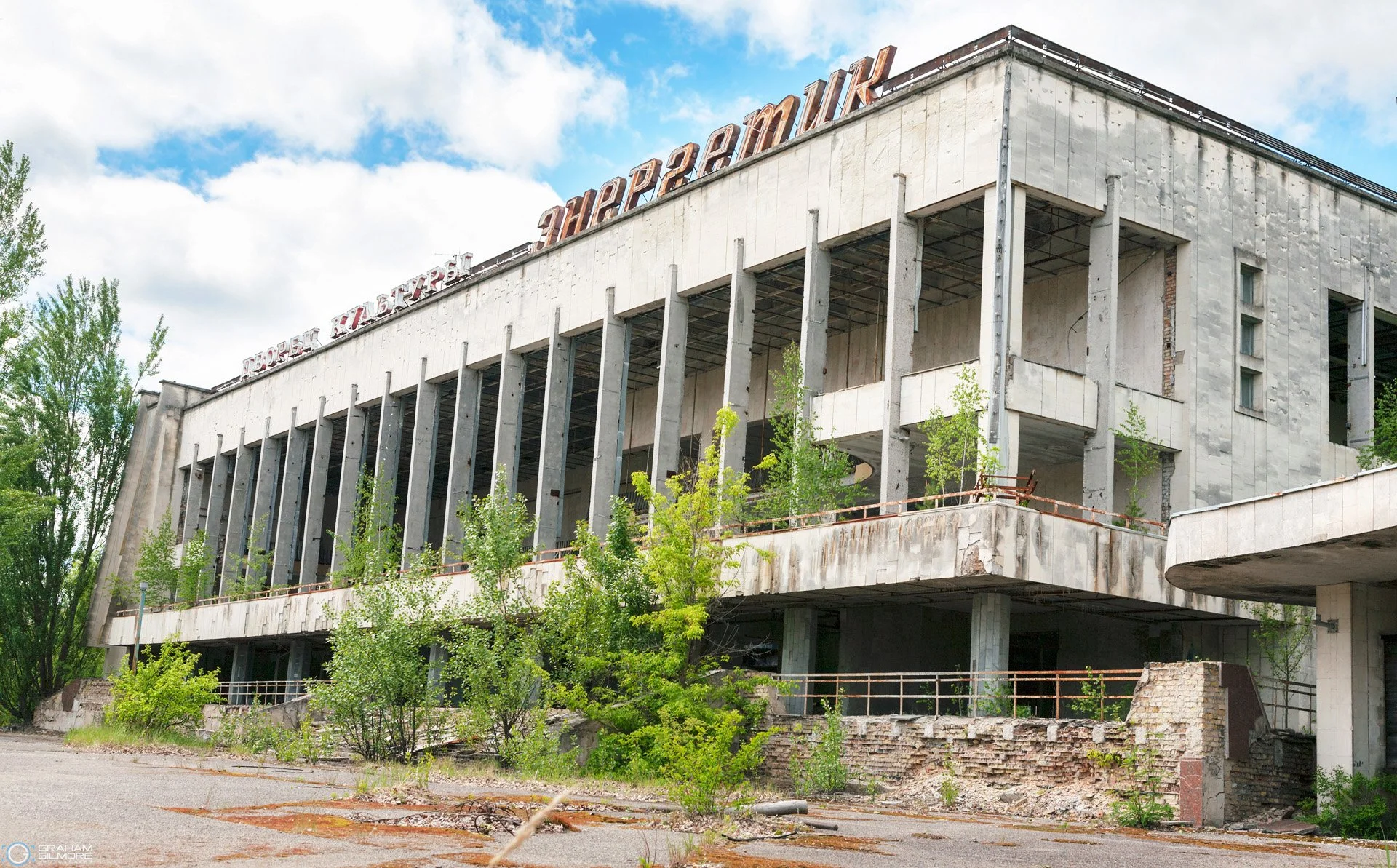
The town square gives you the clearest sense of the city's scale. From the roof of Hotel Polissia, one of Pripyat's two hotels, you can see the whole layout, the Palace of Culture facing the square, a shopping complex further back, and sixteen-story apartment blocks rising above it all. The hardware store Raduga used to sit at the base of one of those blocks, on Lenin Avenue. After the evacuation, the town of Slavutych was built fifty kilometers northeast to house the displaced workers, some of whom still commute in today on a special train that runs straight to the plant without stopping at the Belarusian border.
What was left behind has not stayed still. It has been reclaimed
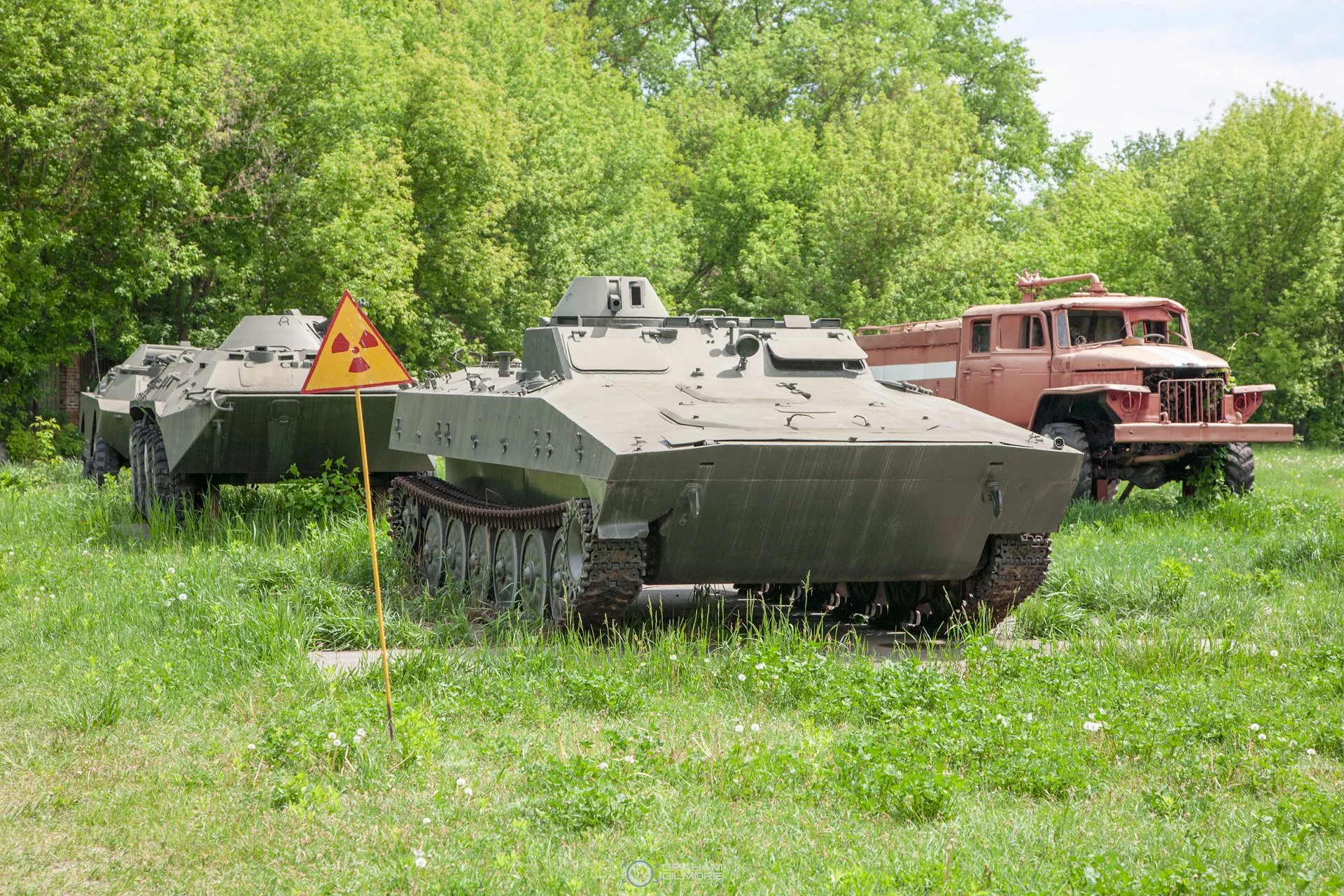
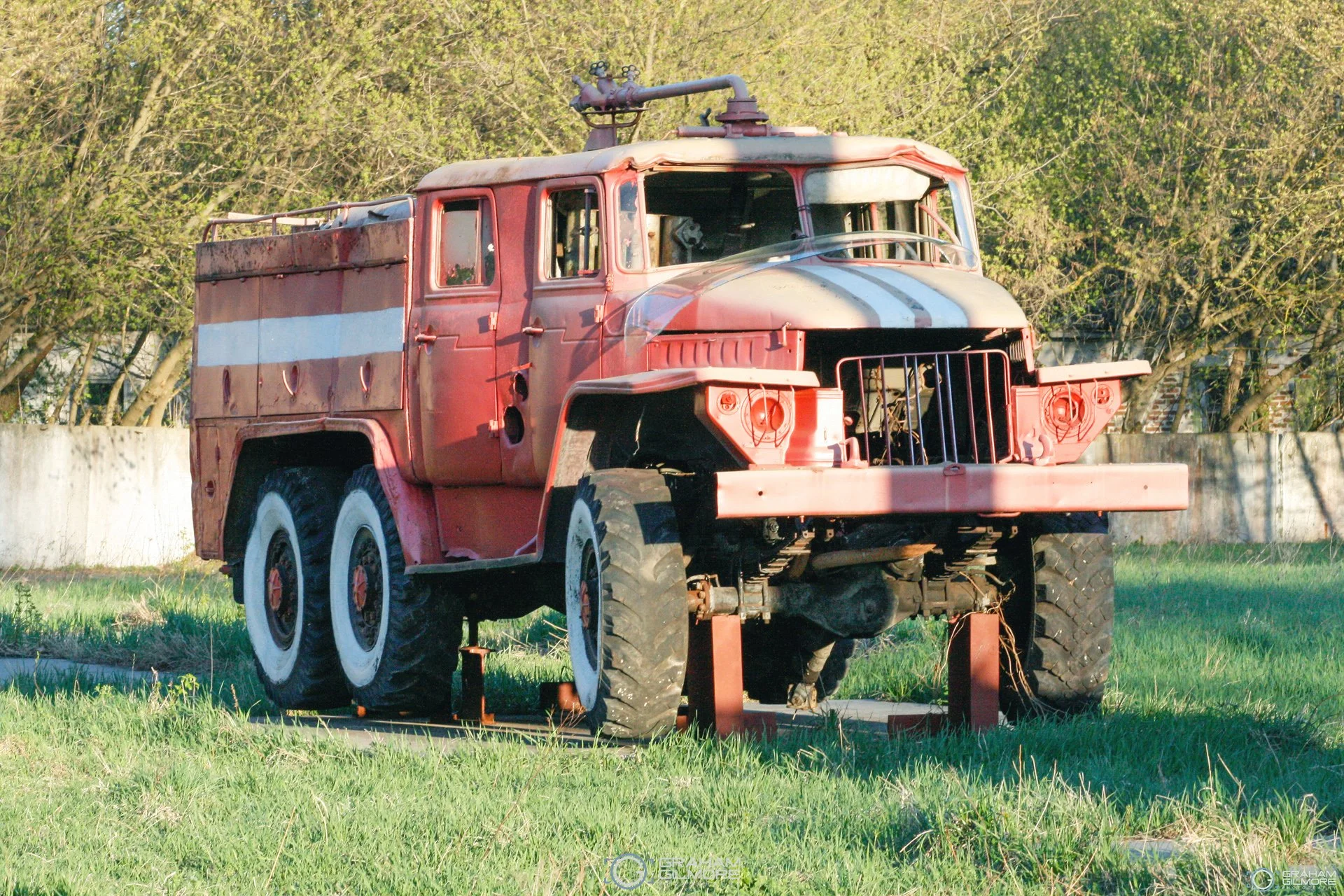
On the southwest edge of the city is the old police station, mostly swallowed by vegetation now. Behind it sit rows of abandoned vehicles, stripped of anything worth taking. These belonged to the liquidators, the military personnel and volunteers sent in to decontaminate the zone by washing down every surface they could reach. Some places were too far gone to save. Kopachi, a village less than four kilometers from the reactor, was bulldozed and buried entirely, all that's left is a monument and a few mounds with warning signs. Fittingly, Kopachi means "gravedigger" in Ukrainian.
Between 600,000 and a million liquidators worked the Exclusion Zone over the years. Estimates vary, but somewhere around 25,000 of them are dead now, and another 70,000 are living with illness from the doses they absorbed. Whatever contamination they managed to wash off the buildings has mostly settled into the soil, where it's sinking at a rate of about a centimeter a year.
Azure Swimming Pool and Sports Complex
This was the main sports and recreation center in Pripyat, and it stayed in use longer than almost anywhere else in the city, workers, scientists and other zone personnel kept using the facilities right up until 1998, over a decade after the accident. Now it's stripped bare like everywhere else. Windows are gone, the floor's buckling and lifting in places, and the whole hall feels like it could give way at any moment.
The pool itself, the Azure, is empty of water but not of everything else, years of glass, debris and fallen building material have piled up on the bottom. The diving board at the far end is still standing, more or less untouched. The old access ladder up to the platform is long gone, replaced at some point by a makeshift one leaning against the structure. At the base of it sits a visitor's notebook, left by people who've passed through over the years, names, dates, a line or two from wherever they came from. We added ours before moving on.
Along the sides of the pool, a lot of the tiles have come away from the walls. In one gap, somebody's painted over the missing tiles with a small figure sitting with a fishing rod, an odd, almost funny thing to find in a place like this. Past it, sections of the outer wall have opened up entirely, and through the gaps you can see the rest of the city outside.
Pripyat Schools
Pripyat had a number of schools and kindergartens, and I made it into three of them across my two trips. In one of the school libraries, the floor is three or four feet deep in books, spines cracked, pages everywhere. Every window's broken, and the whole room looks like something out of a war zone. It got to me a little, standing there, thinking this place will never hear another child reading out loud again.
The corridors were just as unsettling. Soviet-era posters are still hanging in places, instructions for what to do in the event of a Cold War attack from the US, alongside gas masks littering the floors in some rooms, dozens of them. Our guide told us they were originally kept in storage below ground and had been dragged up and scattered over the years. Most are missing their filters now, stripped out for scrap. It's an odd, heavy combination to walk through.
School #1 was the first building in the city to start physically falling apart, its third floor eventually gave way and collapsed to the ground.
Greenhouses and Laboratory
North of the city are the remains of the Pripyat greenhouses, where produce was grown before 1986. After the accident, scientists took the site over for years, using it to study how vegetation handled growing under radiation contamination. The building below is next to the greenhouses and was the old laboratory.
Inside, among the debris, an old upright piano still stands, half taken apart, keys missing, no real reason left for it to be there. It's one of those odd things you find in the zone, completely out of place and somehow more unsettling for it.
Our guide took us upstairs to a doorway that used to hold a steel, lead-lined door, removed at some point and long gone now, nobody seems to know where. He told us the room behind it once held highly radioactive soil samples, some of which are apparently still in there. He wouldn't let us go in. He held the Geiger counter up to the doorway instead, and it started ticking fast and loud enough that we didn't hang around.
Once the scientists eventually left, the place fell apart, and whatever was left of any value got taken by looters.
Pripyat Hospital
Pripyat Hospital was, by far, the creepiest part of the whole tour. Outside the entrance, a single chair sits abandoned, no obvious reason for it being there, just out of place enough to notice. Inside, the waiting area is still recognizable in shape even though everything useful has been stripped from it. A large planter stands near the windows, whatever was growing in it long dead now.
Further in, the corridors narrow and darken, and we moved through room after dark room, a maze of hallways, with drug vials and broken bottles cracking underfoot the whole way. Smaller things kept turning up among the debris, a child's toy, a rubber bottle, a lone seat, all left behind without any explanation, just sitting there. Lift shafts and stairwells dropped off into pitch black in places, which didn't help the atmosphere.
The operating rooms are stripped down to their frames now, equipment long gone, only the outlines of what used to be there left behind. In one of the smaller rooms, rows of metal cots are still lined up, some overturned, a few still holding thin, worn mattresses. Light comes in through the broken windows, and it's a strange contrast, the bare little room against the overgrowth pressing in outside. In another room the beds are more orderly, still aligned along the walls the way they would have been.
Some of the first firefighters exposed on the night of the accident were reportedly brought here before being sent on to hospitals in Moscow. At least one of them never made it out alive. Other visitors have told me they felt like they were being watched moving through the hallways. I didn't get that exact feeling myself, but there was definitely something uneasy about the place.
Pripyat Amusement Park
Near the edge of the park is Pripyat Stadium, once home to a running track, a football pitch, and other sports facilities. In the days after the accident, it was used as a landing zone for helicopters working to contain the reactor fires, and later for transporting the sick and injured out to the nearby hospital. Radiation levels there are still high because of this, so we kept to the perimeter and moved on toward the amusement park itself.
Near the entrance is a small ticket booth, triangular, still standing after all this time even though nobody's bought a ticket there in decades.
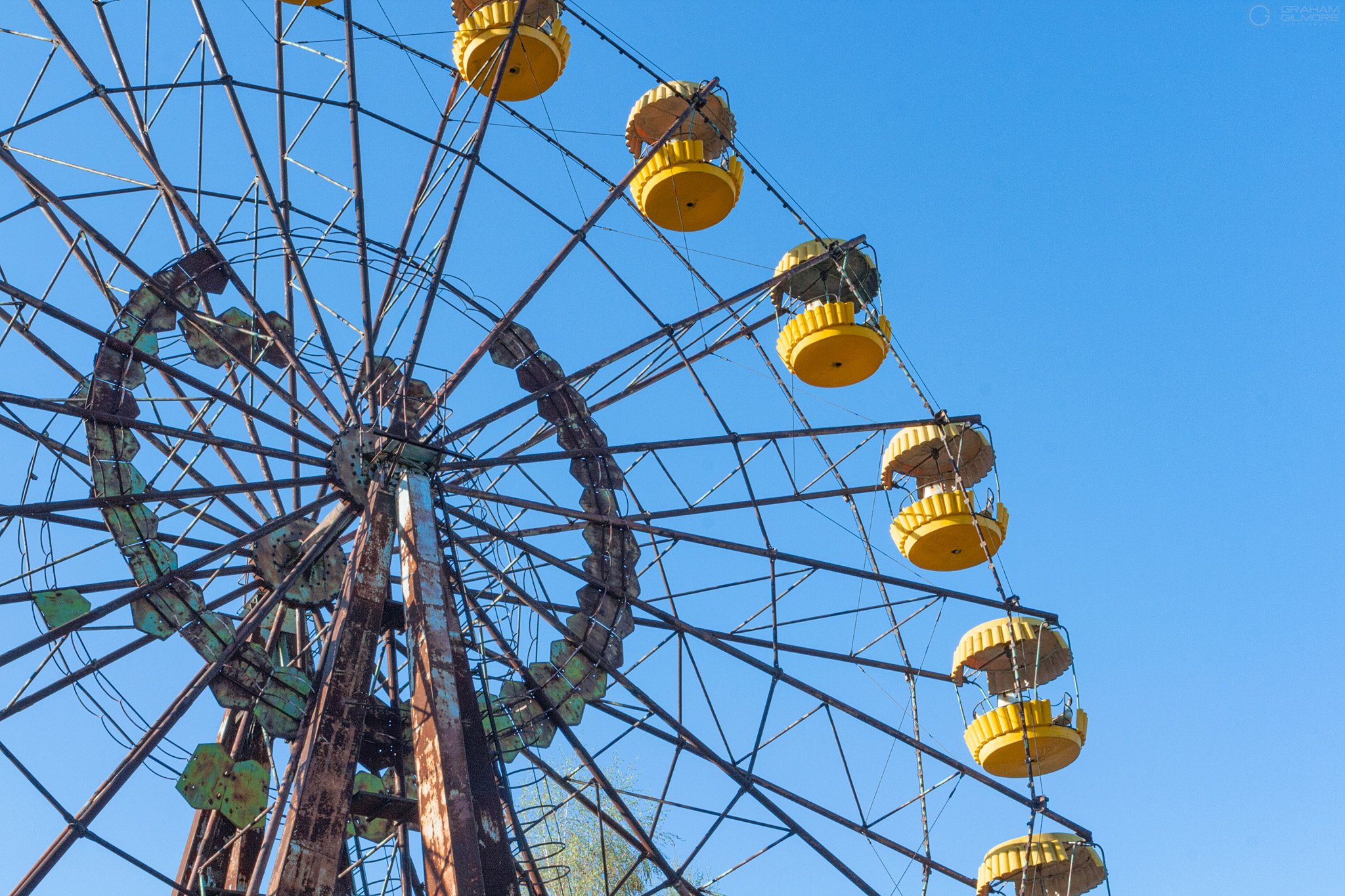
The amusement park is, without question, the most striking part of Pripyat. It sits behind the Palace of Culture, right in the center of town, and had four rides: bumper cars, swing boats, a carousel, and the Ferris wheel. Radiation levels vary a lot across the site. The liquidators did a decent job washing most of it into the soil, so the paved and concreted areas are relatively safe to walk. I'd gone in assuming the bumper car ring would be one of the worst spots, but our guide told us it's actually one of the cleaner areas. It's the edges, where leaves and moss have built up over the years, that hold the radiation closer to the surface. He pointed out one patch of moss about ten feet from the ride, roughly a square meter, that read 25 µSv/h on the dosimeter, one of the highest readings we got anywhere in the city. Most of that's down to helicopters also landing here during the cleanup.
Standing in that part of the city, the atmosphere shifts. Mostly it's just wind and the occasional bird. Then there's the Ferris wheel, towering over everything, and it plays tricks on you, you half expect to hear the motors running or kids shouting from the other rides. The near-silence against something that big makes you notice the quiet even more, and wherever you go in the park, you're always aware of that wheel standing over you. It's probably the single most affecting place I visited in the whole zone, and it's stuck with me since.
Off to the side of the park is an old shooting range, still mostly intact. On one of its walls somebody's painted a small figure blowing giant bubbles, a strange, almost cheerful little image to find surrounded by everything else here.
There's a rumor that the park was supposed to open on May 1, 1986, just five days after the explosion, and that it never actually got used. For years I believed that too. It turns out that's not quite true, archive photos have since surfaced showing the rides really were used, at least briefly, before the accident. I went into that in more detail in a separate post on the amusement park, with the archive images side by side with my own.
Yanov Station
Heading out of Pripyat, about half a kilometer west of the Bridge of Death, is Yanov railway station. Getting access here needs special permission from Chornobyl Interinform, for reasons nobody ever explained to us, the main station building's now used for storage, but what's actually in there, our guide wouldn't say either. We got lucky and were allowed into the yard.
Yanov was the main pickup point for people arriving by train into Pripyat in the hours after the explosion, our guide told us that anyone who came through here during that time was moved straight off the trains and onto buses, then sent right back out of the area.
It's a good spot to explore on foot, the tracks and what's left of the platform are still walkable. A lot of train cars are still sitting around, on and off the rails, most of them rusted through and too dangerous to even step inside because of contamination. Along the tracks there's the same kind of large, strange metal debris you find near the unfinished cooling towers back at the plant. On top of everything else, there were grass snakes slithering around our feet the whole time. Yanov was a highlight of my second trip, and it gave me some of my favorite photos from either visit.
The sense of departure remains, even without movement
The Red Forest
Leaving Yanov, we started heading back down toward Chornobyl town, passing close by the power plant again on the way. Our guide pulled the car over right next to what's known as the Red Forest, one of the most heavily contaminated patches in the whole zone, close enough to the reactor that the trees here took the worst of the fallout in 1986. Once the pine needles turned that reddish-brown color from the radiation, most of this forest was cut down and buried where it stood.
He stopped beside a bush at the roadside, some kind of marker he clearly knew to look for, and as soon as he pointed it out, our Geiger counter went off louder than at any other point on the whole trip. We sat there for a few seconds, and then he pulled away fast. I had a video camera running the entire time, you can see that clip in this post covering more of the zone, along with a set of photos I never included in this essay.

The Outer Villages of the Zone
Beyond the bigger, better-known towns, there are dozens of small rural villages scattered across the Chornobyl Exclusion Zone. Add Pripyat's 49,000 residents to those from Chornobyl city and the surrounding villages, and the total evacuee count comes to roughly 116,000 people. Some of these villages were razed and buried entirely, others were just left to rot.
In the months after the accident, plenty of residents from the outlying villages snuck past border patrols to move back into their old homes illegally. Locally, they're known as Samosely, self-settlers, squatters. We visited one of these villages, Illintsi, which used to be home to around 4,000 people and now has maybe forty left. Walking around felt like stepping back in time, since the original settlers there predate Pripyat and the power plant by generations. It's worth knowing the plant was originally proposed for a site only 25km from Kyiv, but experts at the time decided that was too close to the capital and pushed it out to the Chornobyl region instead. In hindsight, obviously the right call.
While we were in Illintsi, we met an elderly samosely named Maria Shaparenko. Maria was 82 at the time, and had crept back into the zone not long after the evacuation, dodging guards and patrols to get back to the only home she'd ever known. She'd just finished repainting the whole house, inside and out, no small task for someone her age living alone. Following our guide's suggestion, we brought her bags of food and drink as a gift. In return, she tried handing us bottles of vodka, which our guide politely declined on our behalf. Her husband had passed away years earlier, and she was still growing her own food and keeping chickens and other animals by herself. Radiation didn't seem to bother her much, and given how healthy she looked, she was clearly one of the lucky ones.
She told us, laughing, that some important-looking stranger had shown up the previous weekend. They'd shared a long meal together, and it wasn't until he was leaving that he mentioned he was actually one of the heads of the power plant, checking in on her. She found that hilarious. Something in me kept wanting to photograph her and her home, but I couldn't bring myself to do it. She was warm and kind enough that I wanted to just leave her in peace and keep the memory for myself instead. Before we left, she handed us some chocolate, and we went on to explore the rest of the village.
The City of Chornobyl
Like Pripyat, the whole town was washed down after the accident. On top of that, the topsoil was stripped away and all the water piping was moved above ground. Even with all that, there are still pockets of contamination around Chornobyl, though they're well documented and known at this point. Workers here stick to a two-weeks-on, two-weeks-off rotation to limit how much radiation they're exposed to over time. A few people have also moved back full-time since the accident, their houses have signs out front reading "Owner of This House Lives Here," mostly to keep looters away.
The city of Chornobyl itself, Chernobyl being the old Soviet spelling of the Ukrainian name, sits about 14km south of the plant. The CNPP is actually named after the town, not the other way around. Chornobyl's been settled since the 1100s, and before the accident it had around 14,000 people living there. These days, about 400 people work within the zone based out of the town: scientists, military, guards, and Chornobyl Interinform staff and administrators, the same people who run the guided tours and keep an eye on everything happening in the zone.
There's a monument in Chornobyl city dedicated to the firefighters and liquidators who died in the aftermath of the explosion. A lot of them are still alive today, but living with illnesses and disabilities from the radiation exposure they took on, both during the night of the accident and in the weeks and months of cleanup that followed. The monument was actually built by the current firefighters of Chornobyl city, and it stands right in front of their station.

In the evenings, we'd walk from the Interinform hotel across part of town to the local shop for snacks, drinks, cigarettes, that kind of thing. Our guide stayed with us the entire time we were out, since the military presence in Chornobyl is pretty heavy. Anyone wandering around alone and unrecognized gets stopped, questioned, and had better have the right paperwork and a decent reason for being there. I've got more photos from around town, along with a set of Holga film shots from this same trip, over in this post covering the rest of the zone.
Rossokha — The Vehicle Graveyard I Missed
I get asked about the Chornobyl vehicle graveyard at Rossokha a lot, so I figured it's worth explaining properly. There are some great photos floating around online of this site, about 20km southwest of Chornobyl city, where most of the vehicles and helicopters used in the accident response, evacuation, and cleanup were hastily dumped. We were a few weeks too late to see it ourselves.
Our guide explained that because these vehicles were all used directly in the cleanup, radiation levels there were still extremely high even decades on. Combine that with mass looting of the vehicles for parts, and the zone administration ended up shutting the site down to visitors entirely in April 2008. Since then, most of what was left there, cars, tanks, fire trucks, helicopter wreckage, has either been moved elsewhere or buried. These days there's basically nothing left to see on-site, and radiation in the soil there can still hit 300 millisieverts per hour, roughly a third of a lethal dose with prolonged exposure.
Given levels like that, it still baffles me that people were willing to strip engines and helicopter parts out of there over the years, smuggle them out of the zone, and sell them for scrap in Kyiv and the surrounding area.
Final Thoughts
It's hard to put into words how being in the Exclusion Zone actually felt. It clearly had enough of an effect on me to drag me back for a second visit, and the idea of a third still sits somewhere in the back of my mind. These days, whether I'd even be able to go back isn't really in my hands anymore. The zone exists in a very different world now than the one I visited.
Whenever I used to tell people I was planning to visit Chornobyl, most reacted like I'd lost my mind, like I was signing up for a slow death. That's not really how any of it works. Your guide knows exactly where not to step. And when it comes to radiation, what matters is how much you absorb over time, not some instant "touch it and you're dead" scenario, which is what most people seem to picture. Most of Chornobyl city and Pripyat has been cleaned thoroughly by the liquidators, and whatever radiation's left has mostly settled into the soil by now. Stick to paved roads and paths, and your exposure stays low. I've heard it compared to spending a day or two up at 35,000 feet on a long-haul flight, or a week sunbathing on a beach, no real way for me to prove that, but after two trips, and almost 20 years later, I feel fine, and we always got checked by two separate radiation detectors on the way out. Came back clean both times.
Between the two trips I shot over 700 photos and three hours of video, something like 30 gigabytes of material. I've been slowly working through all of it since, and a fair bit of it has ended up on my blog over the years, more than I could ever fit into one essay. There's still plenty more I could've put on this site, but there are other Chornobyl photographers out there doing great work too, and I'm happy to leave some of that ground to them. I also somehow talked a different friend into joining me each time. Never thought I'd find someone crazy enough to come with me into No Man's Land, but I did, twice. Thanks to Paul Colley and Philip Morris for their support on this project. It's a fascinating place, and I think all three of us would say it changed something in us.
All the adventure aside, there's a genuinely serious side to this, both to the disaster itself and to writing about it. Reports on the long-term health effects still conflict with each other. My heart goes out to the kids affected by all this, especially thinking about the ones who should still be around today, riding the amusement park, sitting in those classrooms. There are charities out there working to help children dealing with radiation-related illness.
I also want to clear up a couple of persistent myths. First, Elena Filatova and her Kiddofspeed.com story was partly fabricated. She did visit the zone, like plenty of others, but she never actually rode a motorcycle through it. My guide confirmed motorcycles are strictly banned by zone administration, and another guide I spoke to remembered her visit and thought it was strange she carried a motorcycle helmet around purely as a photo prop. Her account is romantic, sometimes almost mystical, but she was a guided tourist like the rest of us, nothing more. Second, stories about three-legged chickens and other grotesquely mutated animals are myth, none of that's ever been confirmed. There have been some legitimate scientific reports of minor abnormalities in a few bird species, but nothing close to what the rumors describe. And the area's no dead zone either, flowers, trees, horses, boars, deer, it's thriving out there and genuinely beautiful.
Nature's clearly reclaiming this place after the mess we made of it. Ironically, the one species that still can't live here freely is us, the ones responsible for it in the first place. There's something fitting about that, being locked out, in a sense, punished, as a reminder of what happens when nuclear power isn't given the respect it demands.
This piece is dedicated to my father, Ian Gilmore, who passed away between my two trips, on September 9th, 2008, from cancer. I got to see him one last time that April, passing through the UK on my way to Chornobyl. He thought I was completely nuts for going, but he supported me anyway, like he always did.